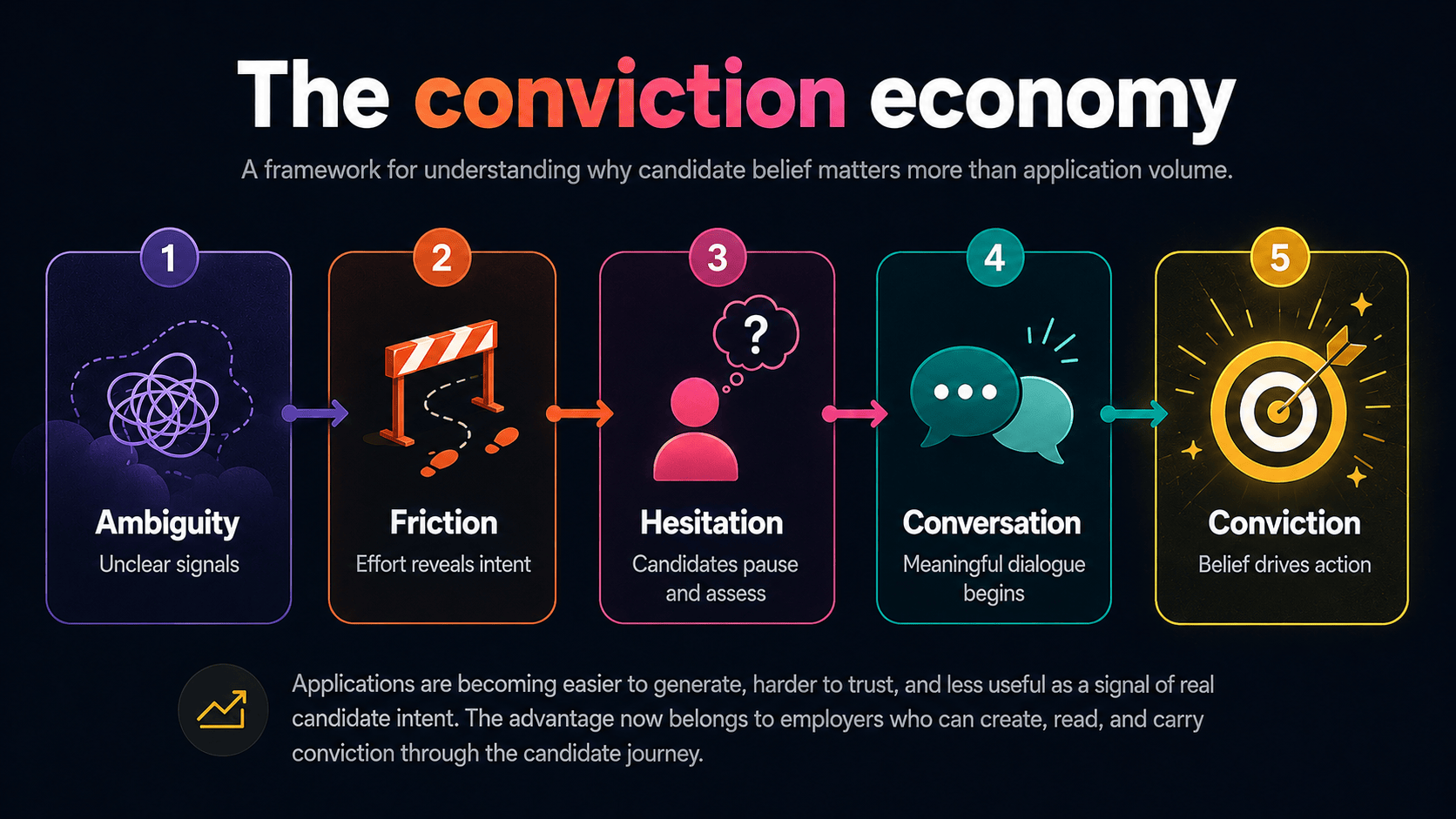
The Conviction Economy 

 A four-part thought leadership series by Bryan Adams on why candidate belief matters more than application volume in the age of AI-generated applications.

 Applications are becoming easier to generate, harder to trust, and less useful as a signal of real candidate intent. The advantage now belongs to employers who can create, read, and carry conviction through the candidate journey.
Collaborative office environment (1)

Why this matters now

Hiring teams have spent years optimizing for more applications. But when applications are free, infinite, and increasingly generated or assisted by AI, volume becomes a weaker signal.

The more useful question is not “how many people applied?” It is “who understood the opportunity, believed it was right for them, and moved forward with intent?”

The Conviction Economy explores four shifts changing candidate experience: the cost of ambiguity, the role of meaningful friction, the value of hesitation, and the need to carry careers site insight into recruiter conversations.

The four-part series follows the journey from unclear candidate questions to informed candidate commitment. Each article explores one point where belief is either built, lost, or carried forward.

Price of ambiguity

 Every unanswered candidate question moves somewhere else, often to your recruiters. The first shift is learning how to find the most expensive silence on your careers website and fix it first. 

Calibrate friction 

 The best candidate experiences use the right friction to help better-fit candidates lean in and wrong-fit candidates opt out with clarity. 

Read hesitation 

 In a world of AI-generated applications, pre-apply behavior may be one of the most honest signals left. Hesitation shows where real people are weighing real decisions.


Carry context 

Careers site insight should not die in a dashboard. It should help recruiters understand what candidates already care about before the first conversation begins. 


 What is The Conviction Economy?

The Conviction Economy is the shift from measuring candidate action to understanding candidate belief. When applications are easy to generate, the real advantage comes from knowing where candidates hesitate, what they need to believe, and how careers experiences help the right people move from interest to commitment.

For talent acquisition and employer brand leaders, this means treating the careers website as more than a place to host jobs. It becomes a system for creating clarity, reading intent, and improving the quality of human conversations that follow.

The Conviction Economy framework-1
WK 2 - BLOG WEBSITE

Read the Series

The Conviction Economy

Part one

Stop fixing your careers website. Start pricing your ambiguity.

Every unanswered candidate question creates cost. Learn how to find the most expensive silence on your careers website and fix it first.

< Read part one
WK 3 - BLOG WEBSITE (1)

Read the Series

The Conviction Economy

Part two

Friction is a love language

Friction is not the enemy of candidate experience. Meaningless friction is. Learn how to use the right effort at the right moment to improve candidate commitment.

< Read part two
BA article - blog image-1

Read the Series

The Conviction Economy

Part three

Hesitation is the last honest signal

When AI can generate applications at scale, pre-apply behavior becomes more important. Learn why hesitation may be the most useful signal left.
Coming soon
WK 4 - BLOG WEBSITE

Read the Series

The Conviction Economy

Part four

The most expensive gap in hiring is between a click and a conversation

Your careers website already knows what serious candidates care about. Learn how to turn that insight into better recruiter conversations.

Coming soon
WK 2 - BLOG WEBSITE
WK 3 - BLOG WEBSITE (1)
BA article - blog image-1
WK 4 - BLOG WEBSITE

 Frequently Asked Qustions

What is The Conviction Economy?

 The Conviction Economy is the shift from measuring application volume to understanding candidate belief. It argues that as applications become easier to generate, employers need to focus more on clarity, intent, hesitation, and informed commitment.

Why are applications becoming a weaker hiring signal?

 Applications are becoming easier to create, automate, and scale, especially with AI-assisted tools. That means application volume alone is less reliable as a measure of real candidate interest, fit, or commitment.

What is candidate conviction?

Candidate conviction is the informed belief that a role, company, and opportunity are worth pursuing. It is built before apply through clear content, realistic expectations, useful proof, and meaningful human follow-up.

What is pre-apply behavior?

 Pre-apply behavior is what candidates do before submitting an application. It includes the pages they visit, content they engage with, questions they explore, where they hesitate, and whether they return before acting.

How can careers website insight help recruiters?

 Careers website insight can show what candidates looked at, where they paused, and what information mattered before they applied. That context can help recruiters have more relevant, confident, and useful first conversations.

 Turn candidate behavior into better hiring conversations

 Happydance careers websites help talent teams understand how candidates move from interest to action, where they hesitate, and what they need to feel confident enough to apply.